
What Actually Happens When Your Long Island Parking Lot Is Resurfaced
When a commercial parking lot is resurfaced the right way, two things happen. First a milling machine grinds off the top two inches or so of worn asphalt. Then a paving crew installs a new hot-mix surface course in its place, compacted while it is still hot, and the lot gets its layout striped back on. Done in phases, a typical commercial lot stays open through the work and each section carries traffic again within a day.
That is the short answer. The longer answer explains the part most property managers never see: why the grinding step exists at all, when you can skip it, and why the question “can we just pave over it?” is usually how a lot ends up buying the same repair twice.
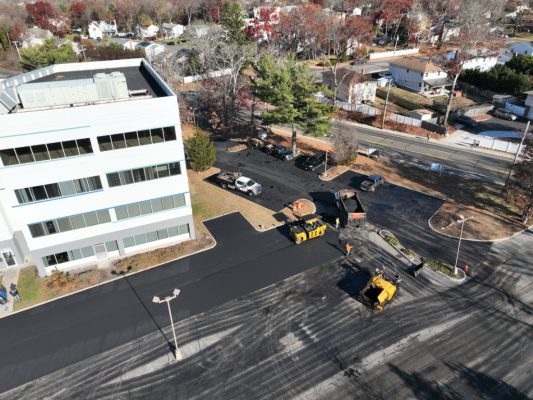
What asphalt milling actually is
A milling machine is a rolling drum of carbide teeth that chews the old surface off at a precisely controlled depth, loads the grindings into trucks, and leaves a clean, textured base ready for new pavement. The depth is the point. Milling takes off exactly the failed layer, typically about 2 inches, without disturbing the sound structure underneath.
The old asphalt does not go to a landfill. Milled asphalt, called reclaimed asphalt pavement, is the most recycled material in America. Nearly all of it, about 95 percent, goes back into new pavement. The lot you drive on after a mill and pave very likely contains pavement from someone else’s old lot.
Why not just pave over it
An overlay, new asphalt installed directly on the old surface, has its place. On a lot with sound structure, correct elevations, and only surface wear, an overlay is the economical call, and we recommend it when it fits.
But an overlay inherits everything underneath it. Cracks in the old surface telegraph up through the new one, often within a year or two, and the money spent on the new surface goes into hiding a problem instead of removing it. There is also a geometry problem: an overlay raises the lot roughly 2 inches. Curbs lose their reveal, water stops flowing where the original design sent it, ADA ramps and door clearances go out of spec, and the low spots that used to drain now pond. Standing water is the fastest way to shorten new pavement’s life.
Milling solves both problems at once. The failed material leaves the site, and the new surface goes in at the original elevation, so drainage, curb lines, and accessibility all work the way the lot was engineered to work. Fix what fails. Preserve what works.
When it’s bigger than the surface
Milling and paving renews the surface course. It does not rebuild the foundation. If a lot shows alligator cracking across large areas, soft spots that move under a truck, or patches sitting on top of older patches, the base underneath has failed, and those sections need full-depth reconstruction: excavate, rebuild the base, and pave new. On most lots that is true for a few sections, not the whole field, which is why the site walk matters. Scoping the real mix of overlay, mill and pave, and full-depth repair is the difference between paying for what the lot needs and paying for what a one-size proposal sells.
How a mill and pave actually runs on a live site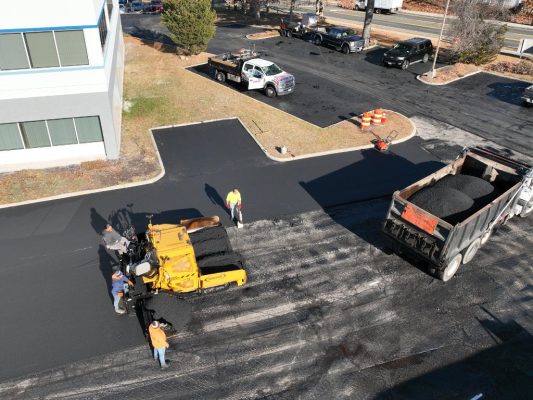
- Site walk and scope. Core problem areas identified, drainage checked, the overlay/mill/reconstruction mix mapped section by section.
- Phasing plan. The lot is divided so tenants, trucks, and customers keep moving. Entrances stay open, and on retail and distribution sites the heavy work often runs nights or weekends.
- Milling. The machine takes the surface off at the specified depth, and the millings leave the site for recycling.
- Structures and repairs. Drainage grates, manholes, and utility structures are adjusted to grade, and any failed base sections are cut out and rebuilt while they are exposed. This is the only time they are cheap to fix.
- Sweep and tack. The milled surface is cleaned and coated so the new asphalt bonds to it as one structure.
- Paving. Hot-mix asphalt arrives hot from the plant and has to be placed and compacted before it cools. Compaction is what gives the surface its density and its lifespan, which is why paving is a race against temperature.
- Striping last. Stalls, ADA spaces, fire lanes, crosswalks, and traffic arrows go back down on the cured surface. A resurfaced lot without its instructions is not finished, it is just black. Lines are what turn new pavement back into a working site.
Each phase reopens as it cools, normally the same day or the next morning, and the sequence moves across the lot until the whole field is done.
Why the calendar decides, again
Hot-mix asphalt has to be compacted while it is hot. Cold air, cold wind, and a cold base steal that working time, and once temperatures fall the regional asphalt plants shut down for the winter, on Long Island generally around December 15. A lot that needs resurfacing in December is waiting until spring, and it waits with water in its cracks through the freeze-thaw season, which is exactly how surface problems become base problems.
The practical read for a Long Island property manager: if your lot is showing the signs below, the fall scheduling window is the one that matters, and the site walk should happen while there is still season left to act on it.
Signs your lot is past sealcoating and into resurfacing territory
- Cracking is widespread and connected, not a few isolated joints
- Patches on top of patches, with new failures opening beside old repairs
- Raveling deep enough that loose stone collects across whole sections, not just at curbs
- Ponding water after rain in areas that used to drain
- A previous overlay that is now cracking in the same pattern as the lot it covered
One or two of these in isolated areas usually means targeted patching plus crackfill and sealcoat, which is a fraction of the cost. Most of them across most of the lot means the surface has done its service life, and maintenance money is better spent on renewal than on chasing failures one at a time.