
By Kim Van Gorder | Reviewed by Dave Nava, Owner | Updated October 2026
Why the freeze-thaw cycle sets the deadline for Long Island parking lots
The best time to fill the cracks in a commercial parking lot is fall, before the first freeze. Cool weather opens the cracks so hot rubberized sealant gets deep, moderate temperatures let it bond, and the water is locked out before winter starts working on the lot. Cracks from about a quarter inch to an inch wide are candidates, and each filled run typically carries traffic again within the hour.
That is the short answer. The longer answer covers what happens to an open crack between December and March, the difference between crack filling and crack sealing, and the cracks that should never be filled at all. Crack filling is not really a repair. It is the cheapest insurance in pavement maintenance, and fall is when the premium comes due.
A crack is not damage yet. It’s a door.
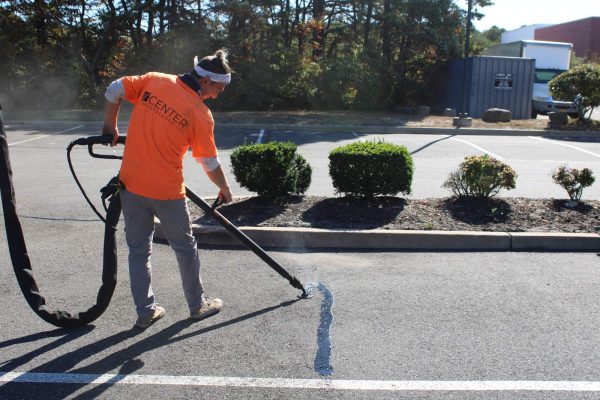 Asphalt moves. It expands in summer heat, contracts in winter cold, and flexes under every truck. Sooner or later that movement opens joints and cracks in the surface. On its own, a quarter-inch crack costs you almost nothing. The pavement still works, traffic rolls over it, and most owners stop seeing it.
What the crack changes is where rain goes. Instead of sheeting across the surface into the drains the lot was designed around, some of it now goes down, into the base layers that hold the pavement up. Everything expensive that happens to asphalt later starts with water getting under it.
The freeze-thaw math
Water takes up more room as ice. Ice is about 9 percent less dense than liquid water (USGS), so water sitting in a crack on a January night pushes the crack wider and deeper when it freezes. The afternoon thaw lets it sink further in, and the next night it freezes again.
Long Island winters are hard on pavement because our temperatures cross the freezing line over and over all season. Every crossing is one more cycle. The Maryland State Highway Administration describes the sequence plainly: water enters the base through surface cracks, freezes, draws more water into the base, and the unsupported surface eventually collapses under traffic (Maryland SHA). By March, the quarter-inch crack is a half-inch crack with a soft base under it, and the lot is on its way to the pothole stage. Emergency patching in spring is almost always fall crackfill that got skipped.
Crack filling vs crack sealing: what the terms actually mean
Bids use the two terms interchangeably. The Federal Highway Administration does not. In its manual on treating cracks in asphalt pavement (FHWA-RD-99-147):
- Crack sealing is for working cracks, the ones that open and close more than about 3 millimeters (roughly an eighth of an inch) a year as the pavement heats and cools. The material has to stick to both walls and flex as the crack moves.
- Crack filling is for non-working cracks that barely move. The goal is to keep water out and reinforce the pavement on either side.
The difference matters because a working crack tears apart any material that cannot stretch. FHWA’s manual says working cracks usually run across the pavement, like the long cracks across a drive lane. On a Long Island lot they open in January and close in July, every year.
In the field, almost everyone calls all of it crack filling, and that is fine as long as the material and the prep match the crack. The questions worth asking on any bid are simple. Is the material hot-applied and rubberized? Are the cracks cleaned and dried right before it goes in? And does the contractor ever route a crack, cutting it into a clean reservoir first? FHWA notes routing is rarely done in filling work and frequently done in sealing.
What hot rubberized crackfill actually is
The only crack material CMC uses is hot-applied. It is a rubberized sealant that arrives as solid blocks, is melted in a heated kettle, and is applied hot into the crack. It flows into the void, bonds to both walls, and cures into a flexible seal that stretches in winter as the crack opens and compresses in summer as it closes. That flexibility is the whole point. A rigid filler cracks loose the first winter. Materials in this class are made to an industry standard, ASTM D6690 (ASTM).
It is worth knowing what the cheap alternative looks like, because the price difference on a bid usually lives here. Cold-pour filler goes in at air temperature from a jug or pour pot, shrinks as it dries, and does not grip the crack walls the same way. A multi-year Texas DOT field study found hot-pour sealants outperformed cold-pour in every district it tested, with adhesive failures showing up mainly in the cold-pour materials (TxDOT / UT Austin CTR). Cold-pour belongs on no commercial lot, which is why CMC does not use it on any job, at any price.
On the surface, the sealant is finished with a thin band over the crack, kept deliberately low so snow plow blades pass over it instead of tearing it out. That matters on any lot that gets plowed, which on Long Island is every lot.
The black spaghetti test: which cracks to fill, and which to cut out
You can do this test yourself on a walk across the lot. Look at the shape of the cracking, not just the size.
- Long, single cracks. Joints between paving passes, cracks running across a drive lane, cracks along curbs and edges. Fill these. This is exactly what crackfill is built for.
- A connected web of small blocks. This is alligator cracking, named for the pattern. Do not fill it. When a crew runs sealant over every line of a web, the result looks like a plate of black spaghetti and buys almost nothing, because the problem is underneath. Caltrans puts it directly: fatigue cracking is structural, and “crack sealing will not treat this type of structural failure” (Caltrans). Maryland’s highway repair guidelines say no crack seal on alligator cracking at any severity, and call for patching instead (Maryland SHA).
- Cracks with crumbling edges. If the pavement along the crack is breaking apart, the crack is past filling. That section gets cut out and patched.
- Hairline surface cracking. Too tight to fill. That is what sealcoating addresses.
FHWA’s manual makes the same point about whole lots: when cracks are numerous or badly deteriorated, sealing or filling them “is both uneconomical and technically unsound.” On most lots the right call is a mix: fill the long cracks, saw-cut and patch the failed areas, and leave the sound pavement alone. Fix what fails. Preserve what works.
Not sure which cracks on your lot are which? We’ll walk it with you and show you what to fill, what to cut out, and what to leave alone. Request a free site walk.
How long crack filling lasts
Longer than most owners expect, when the material and prep are right. FHWA’s manual gives these service ranges from field experience:
- Rubberized sealant in routed working cracks: 5 to 9 years
- Rubberized sealant overbanded on working cracks that are not routed: 2.5 to 5 years
- Rubber- or fiber-modified filler placed flush in non-working cracks: 6 to 8 years
- Plain emulsion or asphalt cement filler placed flush: 2 to 4 years
On a real lot, plows, truck traffic, and how well the crack was cleaned all move those numbers. And new cracks keep forming as the pavement ages, so a filled lot still needs a look every fall. The work is cheap to keep up with and expensive to skip.
Paving over cracks does not get rid of them
Owners planning an overlay or a mill and pave sometimes ask why they should fill cracks at all. The honest answer: paving over a crack does not remove it. Federal research calls it reflective cracking, new cracks that open in an overlay right above the old ones (FHWA). A Wisconsin DOT study found that milling cannot eliminate the reflection of cracks in the pavement below, and that areas with extensive alligator cracking need to be taken out entirely (WisDOT).
So if paving is coming in the next season or two, the scope matters more than the crackfill. Failed areas get cut out and rebuilt before new asphalt goes down, and the timing of any crack work gets planned around the paving date. We cover that in our mill and pave guide.
How it runs on a live lot
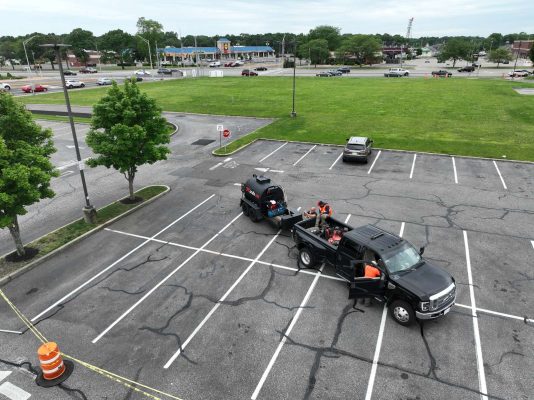
- Walk and map. Every crack that qualifies gets identified, and anything past crackfill (soft spots, alligator areas, potholes) gets flagged for patching instead of wishful filling.
- Clean and dry. Cracks are blown out and cleared of dirt, vegetation, and debris, and the crack has to be dry. Sealant does not bond to wet walls.
- Hot application. The rubberized sealant goes in hot, filling the crack from the bottom, with the thin band finished flush and low.
- Back to traffic. Each run cools and typically carries traffic within the hour. A full crackfill visit on a typical commercial lot is a same-day event, phased so the property never closes.
Crackfill also pairs naturally with sealcoating, since cracks are filled first on every sealcoat job anyway. On a lot due for both, one visit closes the surface completely.
How late in the year cracks can be filled
Later than sealcoat. Sealer needs 50 degrees and rising. Hot-applied crack sealant manufacturers call for pavement above 40 degrees and dry, and warn that lower temperatures can mean moisture or ice in the crack and a weaker bond (Crafco). On Long Island that usually leaves room for crackfill after the sealcoat season has closed, until steady cold arrives. The goal is the same either way: cracks closed before the freeze-thaw season starts.
The cost logic
Crack filling is the least expensive line item in pavement maintenance, and it protects the most expensive one. Left open, cracks feed the failures that cost real money: base washout, potholes, and sections that need full-depth repair years before they should. The owners who almost never buy emergency patching in April are the ones who buy crackfill in October. Plan patching. Avoid panic.
Crack filling on Long Island
Center Maintenance Company has handled commercial pavement maintenance on Long Island since 1994, from Holtsville. Hot rubberized crack filling, sealcoating, saw-cut and hot-mix patching, asphalt repair, and line striping run as one scope with OSHA-trained crews, so the lot gets what it actually needs, crack by crack and section by section. We work across Nassau and Suffolk, including Hauppauge, Smithtown, Ronkonkoma, Bohemia, Massapequa, and Huntington, plus Queens and the NYC boroughs.
The crackfill window is open until steady cold arrives, and the fall schedule fills front to back. Request a free site walk, or call 516-735-2200.
Commercial crack filling and pavement maintenance on Long Island | CMConsite.com | 516-735-2200
FAQ
In the fall, before the first freeze. Moderate temperatures let the sealant bond properly, cool weather opens the cracks so material penetrates deeper, and the water is locked out before freeze-thaw cycles begin.
The Federal Highway Administration uses crack sealing for working cracks that move more than about an eighth of an inch a year, using flexible material that stays bonded as the crack opens and closes. Crack filling is for non-working cracks that barely move. In the field most people call both crack filling. What matters is that the material and prep match the crack.
Working cracks from roughly a quarter inch to an inch wide. Hairline cracking is addressed by sealcoating, and cracks with crumbling edges need patching.
You can, but you shouldn’t. Alligator cracking, a web of small connected blocks, means the base under that area has failed. Filling it just covers the lines. State highway agencies including Caltrans and Maryland call for patching, not crack sealing, on alligator cracking.
A rubberized sealant that is melted in a heated kettle and applied hot, so it flows deep into the crack, bonds to the walls, and cures into a flexible seal that moves with the pavement through winter and summer. It is the only crack material CMC uses.
The sealant cools and typically carries traffic within the hour. A typical commercial lot is done in a day, in phases, without closing.
FHWA field experience puts rubberized sealant at roughly 2.5 to 5 years when it is overbanded on working cracks that are not routed, and 5 to 9 years in routed cracks. Plain emulsion fillers last 2 to 4. Prep, traffic, and plowing move those numbers. Cold-pour fillers sit at the short end, which is why CMC does not use them.
Yes. Sealcoat is a surface coating and does not fill cracks. On a proper sealcoat job the cracks are hot-filled first. The two together are what actually close the surface to water.
Later than sealcoat. Hot-applied crack sealant needs pavement above about 40 degrees and dry, while sealer needs 50 degrees and rising. That usually leaves room for crackfill after sealcoat season ends, until steady cold arrives.