
By Kim Van Gorder | Reviewed by Dave Nava, Owner
Every snow contract is a bet on the winter. A seasonal contract moves the weather risk to the contractor: you pay the same in a 5-inch winter and a 60-inch winter. A per-push contract keeps the risk with you: cheap in a light winter, expensive in a heavy one. Over the last ten winters, Islip got anywhere from 5 inches to almost 66, so the right choice depends less on the price per push than on how much budget swing your property can absorb.
That is the short answer. The rest of this guide walks through the real numbers for Long Island, the ways snow gets priced, the break-even math, and the lines every commercial snow contract should spell out before the first storm.
What Long Island winters actually look like
Islip’s long-term average is 31.8 inches of snow a season (the 1991 to 2020 normal). Almost no winter is average. Here are the last ten seasons at Islip MacArthur Airport:
| Winter | Snowfall (inches) |
|---|---|
| 2016-17 | 39.3 |
| 2017-18 | 65.9 |
| 2018-19 | 12.8 |
| 2019-20 | 6.8 |
| 2020-21 | 33.5 |
| 2021-22 | 37.0 |
| 2022-23 | 5.0 |
| 2023-24 | 10.9 |
| 2024-25 | 11.7 |
| 2025-26 | 61.8 |
Source: NOAA Regional Climate Centers station data for Islip (ISP), monthly totals summed by season; 2025-26 is preliminary. Normals: National Weather Service, Upton office.
Five of those ten winters came in well under the average. Three straight winters stayed under 12 inches, and then 2025-26 delivered 61.8, including the February 2026 blizzard. A contract that looked smart in 2024 looked very different by March 2026. That swing is the whole question.
The ways snow gets priced
The Snow & Ice Management Association (SIMA), the industry’s trade group, defines the common structures in its glossary. In plain terms:
| Structure | How you pay | Who carries the weather risk | Budget certainty |
|---|---|---|---|
| Per push (per service) | Each plowing or salt application | You | Low |
| Per event | A set fee for each storm, however many pushes it takes | Mostly you | Low to medium |
| Per inch | A rate tied to how much fell in each storm | You | Low |
| Seasonal | One fixed price for the season, usually paid monthly | The contractor | High |
| Seasonal with a cap | Fixed price up to a set number of events or inches, then per-event or per-push pricing above it | Shared | Medium |
| Time and materials | Hours, equipment, and materials used | You | Lowest |
Two details change the math more than owners expect. First, salt is often billed per application, even on contracts where plowing is not, so read the de-icing line separately. Second, a long storm can mean several pushes. As one large national contractor puts it, a longer storm “will result in more ‘pushes’… making budgeting more difficult to predict” (BrightView).
The break-even math
You can compare a seasonal quote and a per-push quote without guessing at the weather. Divide the seasonal price by the per-push price. The answer is the number of pushes where the two contracts cost the same.
For example, if the seasonal price equals the cost of 12 pushes, the seasonal contract saves money in any winter that needs more than 12 and costs extra in any winter that needs fewer. Then look at the table above and ask how many pushes your lot needed in a 5-inch winter and a 60-inch one. Add the salt applications, since freezing rain and refreeze nights need salt even when nobody plows.
The real question is not which contract wins on average. It is which risk you would rather hold. A board with a fixed budget and no reserve for a 60-inch winter usually wants the certainty. An owner who can absorb a bad year and wants to keep the light years cheap may prefer per-push. SIMA’s advice is to pick the structure that best fits your “risk tolerance and budgetary constraints” (SIMA).
Trigger depth: the line that decides when anyone shows up
The trigger depth is the amount of accumulated snow that dispatches the crew (SIMA glossary). It is usually the most important number in the contract, and the one owners read least.
A trigger that is set too high saves money and leaves the lot unplowed through storms that still make it dangerous. SIMA has made exactly this point: freezing rain or a light snow can create real hazards well below a plowing trigger (SIMA). Good contracts treat plowing triggers and salting triggers separately, and set a tighter standard for walks and entrances than for the back of the lot.
What every commercial snow contract should spell out
SIMA’s procurement standard for snow and ice services (an ANSI national standard, SIMA-10-2025) lists what a contract should define. The short version for a property manager:
- The service standard. What “done” means. The standard suggests outcome language no stronger than “substantially clear of hazards,” because nobody can promise bare pavement in a storm.
- Triggers. For plowing, for salting, and for walks, each stated in writing.
- Critical times. Opening hours, shift changes, delivery windows, and when the lot must be open.
- Priority areas. Emergency access first, then entrances, exits, walks, and drive lanes.
- Post-storm work. Pushing back piles, clearing catch basins, cleanup after the last flake.
- De-icing materials. What may be used, and what may not (for example near new concrete or landscaping).
- Equipment limits. Anything too heavy or too tall for parts of the site.
- Snow stakes. Who installs them along curbs, islands, hydrants, and drains, and who removes them in spring.
- A site map. Approved stacking areas, high-priority areas, and salt bin locations.
- Damage. Who pays for damage that was not documented in preseason photos or a preseason walkthrough. (More on that in our guide to plow marks on new sealcoat and striping.)
- Insurance. Not just a certificate. One insurer puts it bluntly: “The contract needs to require that you are listed as an additional insured on the contractor’s policy. A certificate of insurance is not enough” (Central Insurance).
Comparing snow contracts for this winter? We’ll walk your lot before the season and quote it seasonal or per push, with salting in the scope either way. Request a pre-season site walk.
Where the snow goes matters as much as when it moves
Snow piles melt, and the melt runs downhill and refreezes overnight. Plow industry guidance is to avoid placing piles where the melt can run across the parking lot (BOSS Snowplow). It is not just good practice. In a 2023 Suffolk County case, a snow pile placed in an elevated area of a parking lot allegedly melted into a stream that refroze, and the appeals court sent the claims against both the property owners and the snow contractor back for trial (Tomala v Islandia Expressway Realty).
Piles also eat parking. A stacking plan drawn on the site map before the season decides which stalls you give up, instead of letting the first big storm decide for you.
Who is responsible when someone slips
This is general information, not legal advice. Talk to your attorney and your insurer about your own contract.
In New York, hiring a snow contractor does not automatically hand off the owner’s responsibility. In the state’s leading case, Espinal v. Melville Snow Contractors (2002), the Court of Appeals held that a contract “standing alone” generally does not make the contractor liable to someone who slips, except in three situations: the contractor creates or worsens the hazard, someone relies on the contractor’s continued work, or the contract entirely displaces the owner’s duty to maintain the property (Cornell LII). In that case, the contract only required plowing above three inches, and the owner kept its duty to inspect.
New York courts also apply a “storm in progress” rule. A 2012 Suffolk decision states that an owner is not responsible for accidents from accumulating snow and ice “until an adequate period of time has passed following the cessation of the storm,” and that once an owner elects to remove snow, it must do so with reasonable care (Cotter v Brookhaven Memorial Hospital).
The practical takeaways: know exactly what your contract makes the contractor responsible for, and keep your own inspection records.
Salt and your pavement
Rock salt is not what destroys most lots. Water and freeze-thaw are. Research on de-icers finds their effect on asphalt has been relatively mild, while freeze-thaw cycles are what break pavement apart. Concrete is more sensitive: federal research found de-icers “amplify the physical mechanisms responsible for freeze-thaw deterioration of concrete” (FHWA), and concrete industry guidance recommends not using de-icers on new concrete in its first year (Pennsylvania Aggregates & Concrete Association). If you have new curbs or walks, say so in the contract.
The best thing you can do for the asphalt before the first salt truck arrives is to close the cracks. Water in an open crack is what winter turns into a pothole. See crack filling before winter.
How CMC prices snow
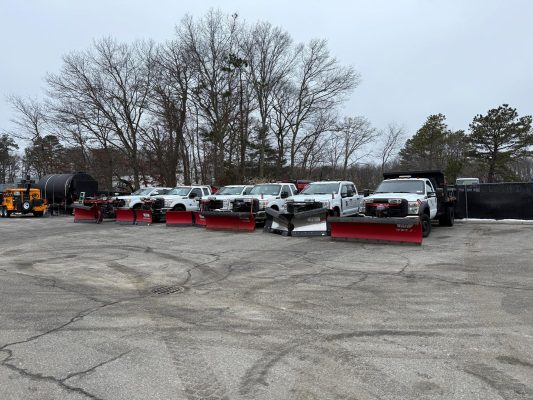 CMC prices commercial snow plowing per site, after a walk of the property, and offers both structures: one flat seasonal number, or per push. Either way, plowing, salting, and sidewalks and entrances are in the scope, and hauling snow off site is billed separately. After the walk, we recommend the one that fits your site and your budget.
CMC self-performs with its own crews and equipment, on commercial properties across Nassau and Suffolk. And because the same company maintains the pavement, the crew plowing in February knows what is under the snow: where the islands, drains, wheel stops, and fresh crackfill are. The lot gets walked, photographed, and staked before the first storm.
If you are comparing snow contracts for this winter, request a pre-season site walk or call 516-735-2200.
Commercial snow plowing and salting on Long Island | CMConsite.com | 516-735-2200
FAQ
Per push charges for each plowing or salt application. Per event charges one set fee for each storm, however many pushes the storm takes. In a long storm, per push can add up quickly.
It depends on how much budget swing you can absorb. Islip has ranged from 5 inches to almost 66 in the last ten winters. A seasonal contract costs the same either way, so it protects you in heavy winters and costs extra in light ones.
The amount of accumulated snow that dispatches the crew. It decides when anyone shows up, so read it carefully, and make sure salting and walks have their own triggers.
Not always. Many contracts bill salt per application even when plowing is seasonal. Read the de-icing line separately. Every CMC snow contract covers salting, including freezing rain and refreeze nights that never reach a plow trigger.
Usually, at least in part. Under New York’s Espinal decision, a contract alone generally does not shift liability to the contractor except in specific situations. Ask your attorney and insurer to review the contract.
Before the season, so the site can be walked, staked, and mapped. Industry staking guidance is to stake curbs, islands, hydrants, and drains in mid-fall.
Whatever the contract says. That is why preseason photos and a written damage clause matter. See our guide to plow marks on new sealcoat and striping.